
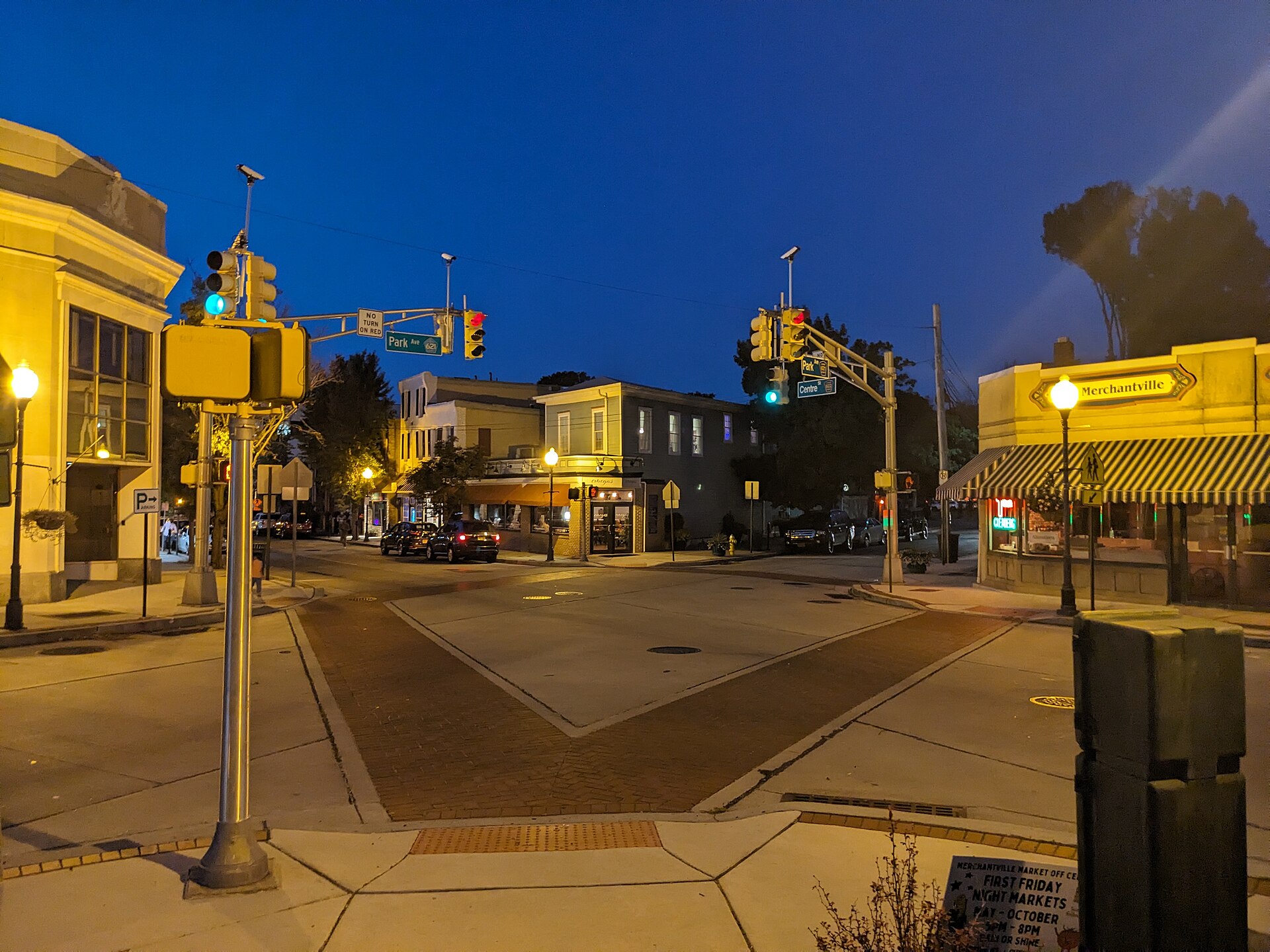
Merchantville is one of the smallest municipalities in Camden County and one of the most architecturally distinctive. Barely over half a square mile, the borough was built out largely in the late nineteenth century as a rail suburb for Philadelphia, and much of that housing stock survives: turreted Queen Annes, deep wraparound porches, carriage houses, and slate roofs on lots that would be impossible to assemble today. For luxury buyers who want character and walkability without a large-estate footprint, it deserves a serious look.
The character of the town
Merchantville’s appeal is its coherence. Because the borough was developed in a compressed period and never expanded much, the streets read as a continuous Victorian streetscape rather than a patchwork of eras. Homes are close enough together to make sidewalks lively but set back far enough to have front lawns and real porches. The compact downtown gives residents a genuine town center to walk to — coffee, restaurants, a few independent shops, and community events.
The scale is the key thing to understand. This is not a town of ten-acre estates. It is a town of substantial, ornate, historically significant houses on village lots. Buyers who want privacy behind a gate will be happier in Moorestown, Medford, or Mullica Hill. Buyers who want to walk to dinner from a house with original pocket doors and a third-floor turret room are in the right place.
What the housing stock looks like
- Queen Anne and Victorian singles. The signature Merchantville house: asymmetrical massing, turrets or towers, decorative shingle work, wraparound porches, high ceilings, and elaborate interior millwork.
- Colonial Revival and Foursquare homes. Slightly later, more restrained, often with excellent bones and simpler maintenance profiles.
- Carriage houses and outbuildings. A number of properties retain original secondary structures, some converted to garages, studios, or guest space.
- Renovated versus original. Inventory varies dramatically between meticulously restored homes and properties carried lightly for decades. Pricing follows that split closely.
Location, commuting, and access
Merchantville sits just east of Pennsauken and north of Cherry Hill, close to Route 38, Route 70, and Route 130, with I-295 and the New Jersey Turnpike a short drive away. The Betsy Ross and Ben Franklin bridges put Center City Philadelphia within a manageable drive outside peak hours. PATCO Speedline stations in nearby Westmont and Haddonfield offer a rail option into Philadelphia for buyers who prefer not to drive, and NJ Transit and the River LINE provide additional regional connections.
Practically, most Merchantville households run larger errands in Cherry Hill or Collingswood, where the bigger grocery and retail options are, and use the borough’s own downtown for dining, coffee, and community life. Haddonfield’s shopping district is roughly ten minutes away, and Philadelphia’s cultural institutions are close enough for a weeknight.
What luxury buyers should evaluate
Buying a high-end Victorian is a different exercise from buying new construction. Focus your diligence here:
- Roof, gutters, and exterior trim. Elaborate Victorian exteriors have many joints, valleys, and decorative elements, each a potential water entry point. Ask for the roof’s age and material and get a close look at soffits, fascia, and porch framing.
- Porch structure. Wraparound porches are the most charming and most frequently deteriorated element on these houses. Check columns, decking, and the footings underneath.
- Mechanical systems. Confirm heating type and age, whether central air exists on all floors, electrical panel capacity, and whether any knob-and-tube wiring remains. Insurance carriers care about the answers.
- Basement and foundation. Look for seepage history, sump systems, and grading around the house. Older stone or brick foundations need honest assessment, not reassurance.
- Environmental items. On homes built before 1978, lead-based paint disclosure applies. Buried oil tanks are a known issue across older South Jersey towns; a tank sweep is inexpensive relative to the risk and is worth doing.
- Permits and prior work. Verify that additions, decks, finished basements, and system replacements were permitted. Unpermitted work becomes your problem at resale.
Historic considerations
Merchantville takes its architectural identity seriously, and buyers planning exterior changes should confirm at the borough level what approvals apply to a specific property before committing to a renovation plan. Get that answer in writing during your inspection period. The same applies to questions about lot coverage, setbacks, and accessory structures on these compact village lots.
How pricing works in a small borough
Merchantville’s small size means limited annual turnover, and that has real consequences for pricing. There may be only a handful of truly comparable sales at the high end in a given year, so condition, quality of restoration, lot position, and off-street parking can move value more than raw square footage. Automated valuations tend to struggle with houses this idiosyncratic.
Sellers benefit from marketing that communicates craftsmanship — photography and copy that show the millwork, the stained glass, the tile, and the restoration work rather than treating the house as a generic four-bedroom. Buyers benefit from an agent who can look at two similar-looking Victorians and explain why one is worth meaningfully more. For current inventory and recent comparable sales, reach out directly rather than relying on public estimates.
Merchantville compared with nearby towns
- Versus Collingswood: Both are walkable and architecturally rich. Collingswood has a larger and busier restaurant corridor; Merchantville is quieter and smaller in scale.
- Versus Haddonfield: Haddonfield offers a bigger downtown, a deeper luxury inventory, and direct PATCO access, generally at a higher price point.
- Versus Moorestown or Medford: Those towns deliver land, privacy, and larger lots. Merchantville delivers walkability, architecture, and a village feel.
Frequently asked questions
Is Merchantville a good commuter town for Philadelphia?
Yes for most schedules. The borough has quick access to Route 38, Route 70, and I-295, with the Betsy Ross and Ben Franklin bridges nearby for a drive into Center City. Buyers who prefer rail typically use PATCO from nearby Westmont or Haddonfield. Commute times vary meaningfully with bridge and highway traffic, so test your route at the hour you would actually travel.
What kind of luxury homes exist in a town this small?
The high end of Merchantville consists mainly of large, restored Victorian and Colonial Revival single-family homes — often four or more bedrooms with original architectural detail, updated systems, and sometimes a carriage house or detached garage. It is a market defined by architecture and restoration quality rather than acreage.
What should I budget for beyond the purchase price?
Plan for ongoing maintenance appropriate to a historic home: periodic exterior painting, roof and gutter work, porch upkeep, and system modernization over time. Insurance for older homes can also price differently depending on wiring, roof age, and replacement cost. Ask for actual utility and maintenance history from the seller where available, and get contractor estimates during your inspection period rather than after closing.
Considering Merchantville or another South Jersey town? James Kennedy works with buyers and sellers of high-end homes throughout South Jersey and Philadelphia and can tell you what is actually available, what recently sold, and what a specific property is worth today. Call James at 215-267-8479 or email jameskennedy@unlockedteam.com.
Leave a Reply