
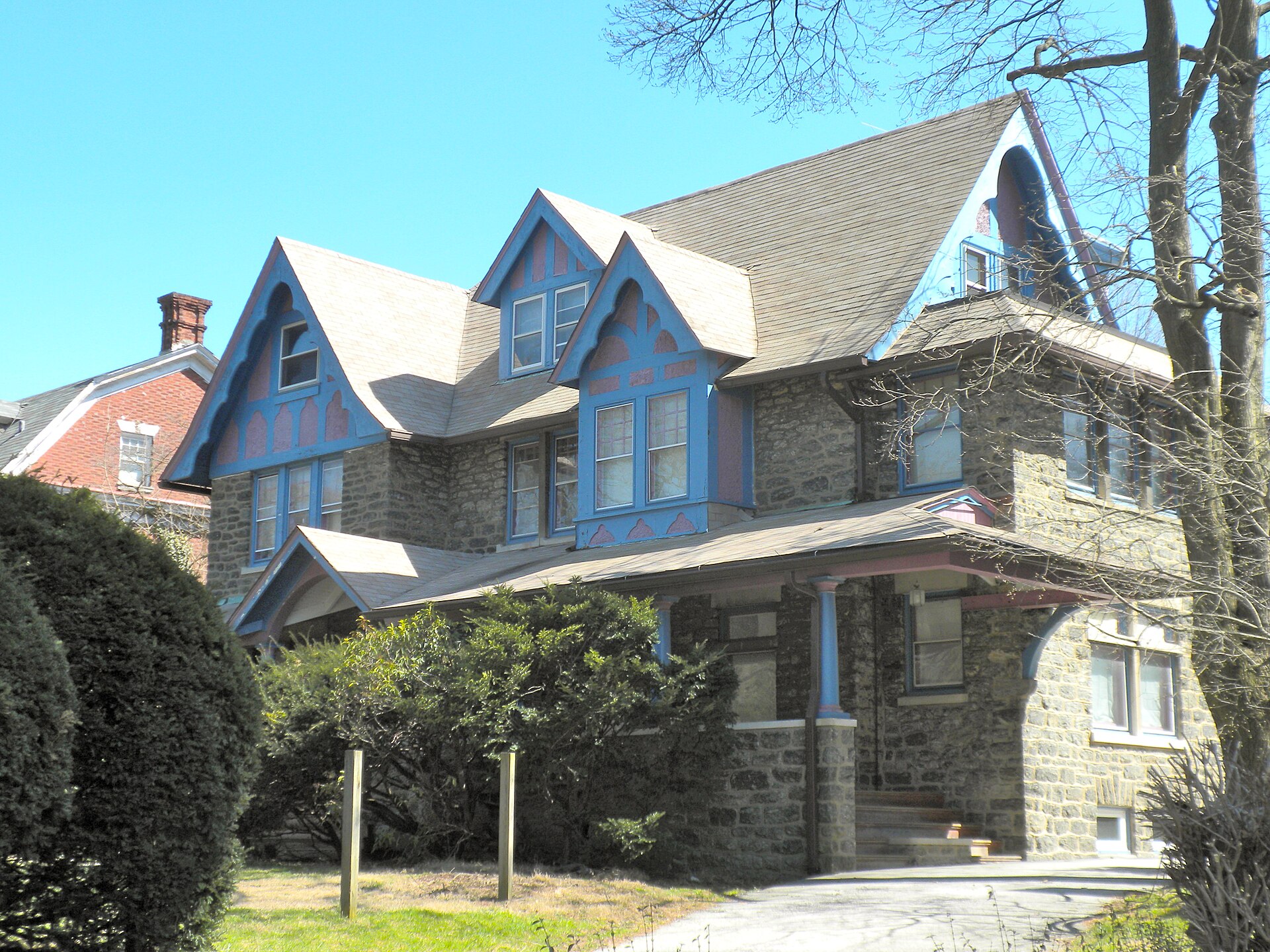
Most buyers who want a large historic home with a real yard assume they have to leave Philadelphia for the Main Line. Overbrook Farms proves otherwise. Laid out in the 1890s as one of America’s earliest planned garden suburbs, it sits at the far western edge of the city, minutes from Lower Merion, yet it is fully within Philadelphia’s boundaries. For a certain kind of luxury buyer, that combination is hard to replicate anywhere else in the region.
What makes Overbrook Farms distinct
Overbrook Farms was developed as a cohesive vision rather than lot by lot. The developers behind it hired accomplished architects, buried utility lines, planted street trees, and imposed deed restrictions on setbacks and materials. The result is a neighborhood that reads as a single composition: broad stone houses on generous lots, curving streets, mature canopy, and consistent scale.
Housing stock leans heavily toward Colonial Revival, Tudor Revival, Queen Anne, and Shingle Style homes in Wissahickon schist, many with slate roofs, leaded glass, quartersawn oak, coffered ceilings, and multiple fireplaces. Square footage is often substantial by city standards, and lot sizes far exceed what a rowhouse-dominated market usually offers. Carriage houses and detached garages appear on several blocks, which matters more than buyers expect in a city where off-street parking is scarce.
Who tends to buy here
- Buyers who want scale, land, and architectural pedigree while keeping a Philadelphia address.
- Professionals tied to University City, Center City, or the western suburbs who value the Overbrook regional rail stop.
- Preservation-minded owners who actively want a historic house and are prepared to steward it.
- Families who want a yard, a driveway, and a front porch without moving to a township.
Location and getting around
Overbrook Farms sits along the City Avenue corridor at the Philadelphia–Lower Merion line. The Overbrook station on SEPTA’s Paoli/Thorndale regional rail line puts Suburban Station and 30th Street Station within a short ride, which makes the neighborhood workable for buyers who commute downtown but do not want to drive. City Avenue provides quick access to I-76 and the Schuylkill Expressway, and from there to the Blue Route and the Pennsylvania Turnpike.
Day-to-day shopping is a mix: Main Line retail in Bala Cynwyd, Wynnewood, and Ardmore is a short drive west, while Center City’s restaurants and cultural institutions are a straightforward rail trip or drive east. Buyers who want to walk to a dense commercial strip should understand that Overbrook Farms is residential by design — the trade-off for its lawns and quiet is that most errands involve a car or a train.
What to evaluate before you buy
Large stone houses from the 1890s and 1900s reward careful diligence. In this neighborhood, focus your inspection budget where the money actually is:
- Roof and masonry. Slate roofs can last a century but are expensive to repair properly. Ask about the age of the roof, flashing, and any repointing history on stone facades and chimneys.
- Systems. Many homes have been converted from original heating systems over time. Confirm the age and condition of HVAC, whether central air is present on every floor, and whether electrical service has been upgraded to handle modern loads.
- Water management. Grading, gutters, downspouts, and basement drainage matter enormously on older stone homes. Look for evidence of past water intrusion and ask what was done about it.
- Windows and envelope. Original wood windows can be restored beautifully, but heating and cooling costs on a large home vary widely depending on insulation and window condition.
- Prior renovations. Confirm permits and workmanship on kitchens, baths, and additions. Quality varies from museum-grade restoration to deferred maintenance dressed up for market.
It is worth hiring inspectors who regularly work on large historic homes rather than a generalist. A specialist reads a 6,000-square-foot stone house differently than a 1,200-square-foot rowhouse, and the difference shows up in what they flag.
Historic designation and neighborhood standards
Portions of Overbrook Farms are recognized for their historic significance, and the neighborhood has a long-standing civic association that takes streetscape and preservation seriously. Before you plan an addition, a new roof material, or major facade changes, confirm exactly what designations apply to the specific parcel and what review, if any, is required. This is a parcel-level question, not a neighborhood-level one, and it should be answered in writing during your due diligence period rather than assumed.
How pricing tends to work here
Overbrook Farms is a small, low-turnover market. In neighborhoods like this, a handful of sales in a year can set the tone, and condition drives dispersion more than location does. Two houses on the same block can be far apart in price if one has a restored roof, updated systems, and a renovated kitchen while the other needs all three. Buyers should expect to underwrite the cost of deferred maintenance into their offer, and sellers should expect that buyers will.
Because comparable sales are limited, pricing here benefits from an agent who has actually walked the inventory rather than one relying purely on automated valuation tools, which tend to handle unique historic homes poorly. For current inventory, recent sales, and what a specific block is doing, reach out directly.
Overbrook Farms compared with the nearby Main Line
Buyers considering Overbrook Farms are often also looking at Bala Cynwyd, Wynnewood, Merion, and Narberth. The honest comparison comes down to a few factors:
- Taxes and jurisdiction. Philadelphia and Lower Merion Township operate under different tax structures, and Philadelphia residents are also subject to city wage tax. Run the full annual carrying-cost math on both sides of City Avenue before deciding.
- Schools. Public school assignment differs across the city line, and many families in this area also consider the region’s independent and parochial schools. Confirm current assignment and admissions details yourself rather than relying on listing remarks.
- Price per square foot. Historic homes of comparable size and grandeur often price differently on either side of the boundary. That gap is precisely why some buyers choose Overbrook Farms.
Frequently asked questions
Is Overbrook Farms actually in Philadelphia?
Yes. Overbrook Farms lies within Philadelphia city limits in the far western part of the city, directly adjacent to Lower Merion Township in Montgomery County. Residents pay Philadelphia property and wage taxes and are served by Philadelphia municipal services, even though the neighborhood’s look and lot sizes feel suburban.
What kinds of homes are available in Overbrook Farms?
The neighborhood is dominated by large late-nineteenth and early-twentieth-century single-family homes in stone and shingle, including Colonial Revival, Tudor Revival, Queen Anne, and Shingle Style examples, many with original millwork, multiple fireplaces, and detached garages or carriage houses. Twins and a smaller number of converted properties also appear.
Is it a good fit if I commute to Center City?
It can be. The Overbrook regional rail station connects to 30th Street and Suburban Station, and City Avenue offers quick highway access. Buyers who want to walk to work or to a dense restaurant district will generally be happier in Center City; buyers who want space, a yard, and a rail commute often find Overbrook Farms an excellent compromise.
Thinking about buying or selling in Overbrook Farms or elsewhere in Philadelphia? James Kennedy specializes in luxury real estate across Philadelphia and South Jersey and can walk you through current inventory, recent sales, and what a specific home is really worth. Call James at 215-267-8479 or email jameskennedy@unlockedteam.com to start the conversation.
Leave a Reply