
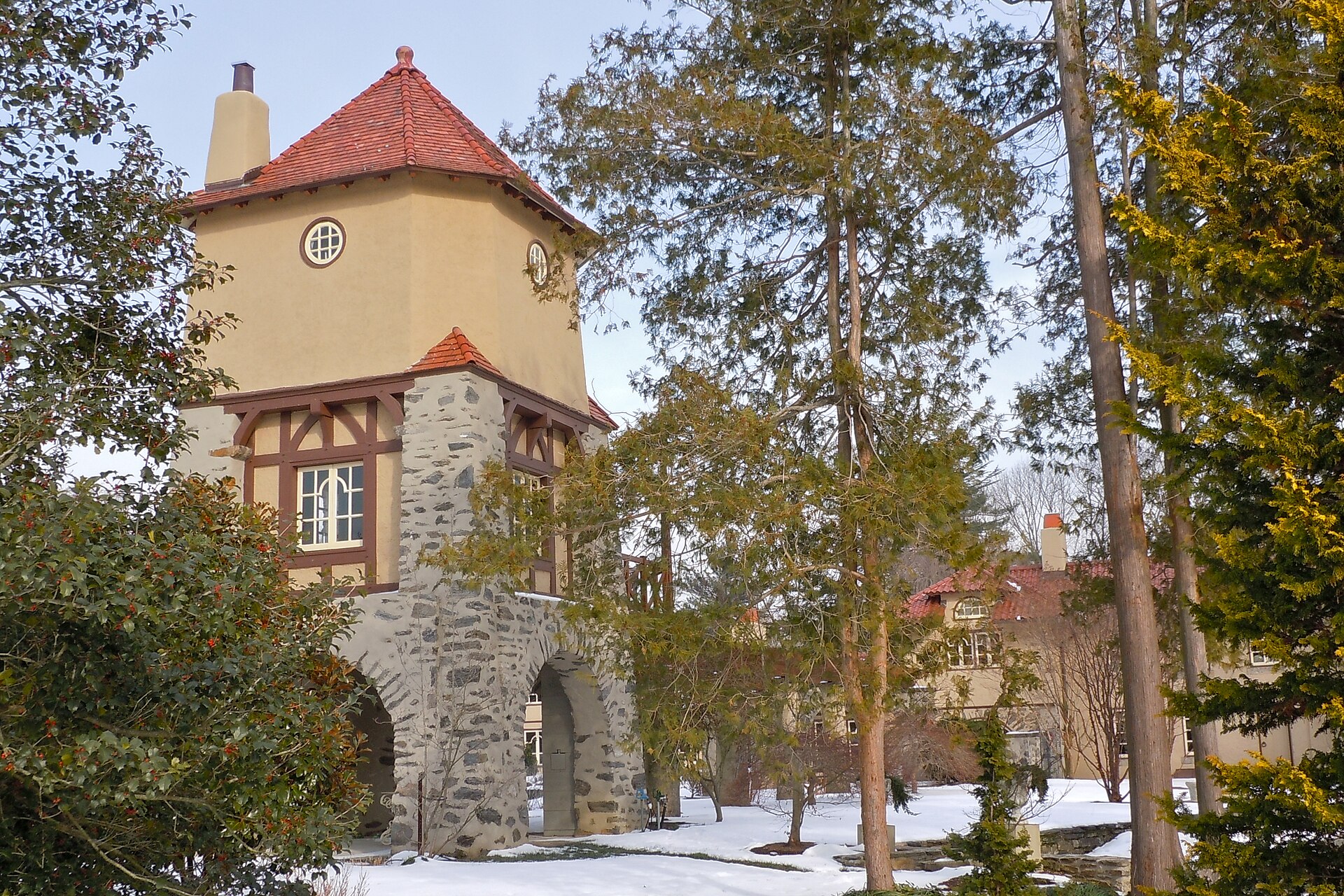
Delaware County’s luxury market is often summarized by a few well-known names, but some of its most interesting properties sit in places buyers outside the county have never heard of. Rose Valley and Wallingford are two of them. They occupy a small, wooded pocket between Media and Swarthmore, they contain some of the most architecturally distinctive houses in the Philadelphia suburbs, and they offer something increasingly rare: a genuine train commute paired with real acreage and mature tree canopy.
This guide covers what these two communities are, what the housing stock looks like, and what to verify before you buy.
Where Rose Valley and Wallingford are
Rose Valley is a small borough of roughly a square mile, bordered by Media, Nether Providence Township, and Middletown Township. Wallingford is not a municipality at all — it is a named community within Nether Providence Township, with its own post office, train station, and identity. In practice, buyers looking at one almost always look at the other, and they share schools, roads, and the same wooded, creek-cut terrain.
Both sit roughly a dozen miles southwest of Center City Philadelphia and within a few minutes of Media Borough, which functions as the area’s downtown.
The Arts and Crafts legacy of Rose Valley
Rose Valley was founded at the turn of the twentieth century as an Arts and Crafts community — an experiment in living where craftsmen, artists, and architects built and worked together around converted mill buildings on Ridley Creek. That history is not a marketing line; it is visible in the housing stock. The borough contains a concentration of early-twentieth-century architect-designed homes, converted mill and industrial structures, stucco-and-timber cottages, and later Modernist houses tucked into wooded lots.
The Hedgerow Theatre, one of the oldest repertory theatres in the country, still operates in a converted mill building in the borough, and the community’s guild and civic traditions remain active. For a buyer who values design provenance, Rose Valley offers something the region’s newer luxury enclaves cannot manufacture.
What Wallingford’s housing stock looks like
Wallingford is broader and more varied. Expect substantial early-twentieth-century center-hall colonials, stone Tudors, shingle-style houses, and gracious mid-century homes on half-acre to multi-acre lots, many with mature specimen trees and stone walls. There is also a supply of well-built 1950s through 1980s houses on larger parcels that buyers frequently take down to the studs and reimagine, and a limited amount of newer custom construction on infill lots.
Lot size and privacy are the defining features. Compared with the Main Line at a similar price, buyers in Wallingford often find more land and more tree cover, with a somewhat less formal social atmosphere.
Schools
Both Rose Valley and Wallingford are served by the Wallingford-Swarthmore School District, which is one of the reasons the area draws family buyers who could afford to shop in several counties. The area is also within easy reach of a number of independent day schools in Delaware County and along the Main Line, and Swarthmore College’s campus and arboretum sit minutes away.
Commuting to Center City
This is the practical advantage that separates Rose Valley and Wallingford from equally leafy but less connected suburbs. SEPTA’s Media/Wawa Regional Rail line runs through the area with stations at Wallingford, Moylan-Rose Valley, and Media, putting Suburban Station and Jefferson Station within a straightforward ride. By car, Interstate 476 (the Blue Route) and Interstate 95 both connect quickly, and Philadelphia International Airport is one of the closest major airports to any luxury suburb in the region — a meaningful factor for buyers who travel frequently.
Lifestyle and everyday life
Media Borough is the anchor: State Street offers a dense run of restaurants, a farmers market, independent shops, a theatre, and a trolley that runs down the middle of the street. For outdoor life, Ridley Creek State Park, the Tyler Arboretum, and Scott Arboretum at Swarthmore are all within minutes, and Ridley Creek itself threads through both communities. It is an unusually green pocket for somewhere this close to the city.
What to check before you buy
- Creek and floodplain proximity. Ridley Creek and its tributaries run through both communities. Confirm the flood zone designation, elevation, and insurance implications on any property near water.
- Mature trees and drainage. The tree canopy is an asset and a liability. Have large trees assessed, and pay attention to grading, downspout discharge, and any history of basement water.
- Historic and architectural review. Rose Valley has a strong preservation culture and portions of it are recognized historically. Confirm what exterior changes require review before planning an addition or window replacement.
- Older systems. Houses of this vintage frequently have knob-and-tube remnants, undersized electrical service, original galvanized or cast-iron plumbing, oil heat, and buried or abandoned oil tanks. Scope each of these specifically.
- Sewer and water service. Verify whether the property is on public sewer or septic, and have any lateral scoped with a camera in a house this old.
- Stucco and stone envelope. Older stucco on frame construction is a known regional issue. Consider a specialist moisture evaluation rather than relying on a general home inspection alone.
- Zoning and lot coverage. If you plan an addition, pool, or accessory structure, confirm setbacks and impervious coverage limits early — some of these lots are irregular.
How Rose Valley and Wallingford compare with nearby options
Buyers frequently weigh this area against Swarthmore, Media, Newtown Square, and the Main Line. Swarthmore offers a tighter, more walkable college-town feel on smaller lots. Media offers walkability and restaurants at the cost of privacy. Newtown Square and Glen Mills offer newer construction and larger new-build communities. The Main Line offers prestige, more retail, and generally higher pricing per square foot. Rose Valley and Wallingford sit in a distinct spot: architecture and land, a short rail commute, and pricing that often surprises buyers who assumed the Main Line was the only option at this level.
Frequently asked questions
Is Rose Valley actually its own municipality?
Yes. Rose Valley is an incorporated borough in Delaware County with its own council, while Wallingford is a community within Nether Providence Township rather than a separate municipality. The distinction affects local ordinances, permitting, and municipal tax lines, so confirm which jurisdiction governs any property you are considering.
Can you get a true estate property this close to Philadelphia?
You can. Both communities include multi-acre wooded parcels with substantial homes, and because much of the surrounding land is parkland or arboretum, the sense of seclusion often exceeds what the acreage alone suggests. Inventory at that level is limited and frequently sells quietly, which is why working with an agent who tracks off-market activity in Delaware County matters here.
What should I expect for property taxes?
Delaware County millage rates and school district taxes vary by municipality, and reassessment history affects individual parcels differently, so a single average is not useful for planning. Ask for the actual current tax record on any specific home and confirm whether recent improvements have been assessed, particularly on a renovated or newly expanded house.
Talk with James Kennedy
James Kennedy specializes in luxury real estate across Philadelphia and South Jersey and works with buyers and sellers throughout the surrounding Pennsylvania suburbs. If you would like current pricing, recent comparable sales, or a private conversation about your plans, call or text James at 215-267-8479 or email jameskennedy@unlockedteam.com.
Leave a Reply