
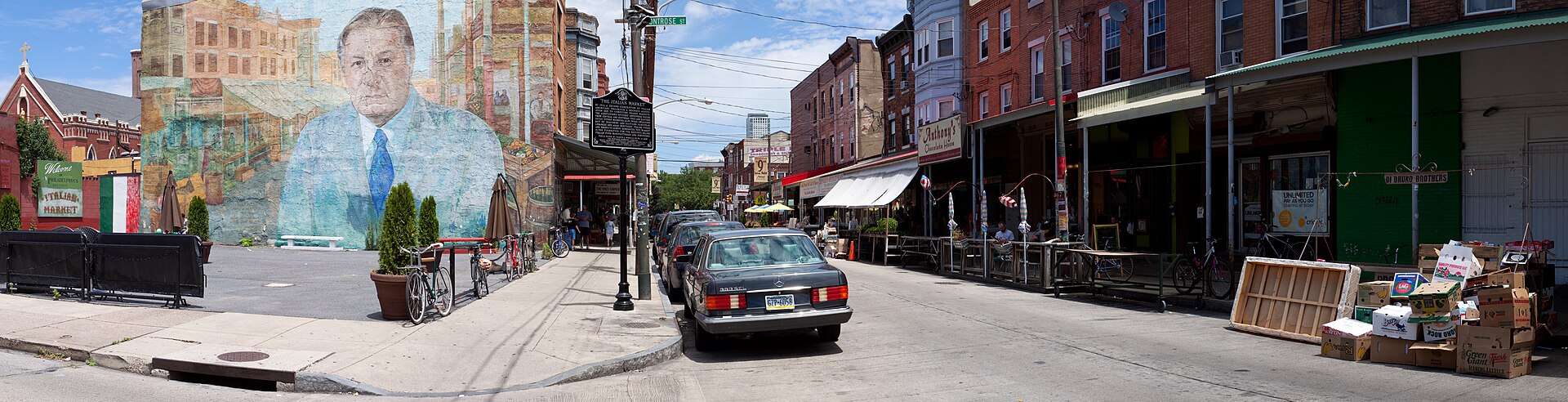
Bella Vista sits just south of Center City, bounded loosely by South Street, Washington Avenue, Sixth Street, and Eleventh Street. It is best known for the 9th Street Italian Market, the oldest continuously operating outdoor market in the country. What buyers at the upper end of the market often do not expect is how quickly the character changes one block off the market corridor: the noise falls away, the streets narrow, and you find restored trinities, wide brick townhouses, and a steady supply of newly built four-story homes with roof decks and garages.
For buyers looking in the higher price tiers who want to be able to walk to Center City but do not want to live in a condo tower, Bella Vista is one of the strongest candidates in the city. It is also a neighborhood where two houses on the same block can be very different products, so knowing what you are looking at matters.
What the housing stock actually looks like
Bella Vista’s inventory falls into three broad categories, and the price-per-square-foot logic is different for each.
Historic rowhouses and trinities
Much of the neighborhood was built in the nineteenth century as workers’ housing. Trinities — three rooms stacked vertically with a winder staircase — are charming and often beautifully restored, but they are small, and the stair geometry does not work for every buyer. Larger period rowhouses on the wider streets can be genuinely substantial, particularly when a previous owner combined two properties or built a rear addition.
Gut renovations
A significant share of high-end Bella Vista sales are older shells taken down to the studs and rebuilt. Quality varies enormously. A well-executed gut renovation with new systems, proper framing, permitted work, and real insulation is a genuinely good buy. A cosmetic flip with new finishes over old problems is not. This is the single biggest area where buyers overpay in this neighborhood.
New construction
Infill new construction — often four stories, with a finished basement, a roof deck, and sometimes a one-car garage — has been steady in Bella Vista for years. These homes tend to be the largest in the neighborhood and command the highest absolute prices. They also frequently carry a property tax abatement, which affects your carrying cost in the early years and then steps up.
Which blocks hold value
Bella Vista rewards block-level knowledge more than most Philadelphia neighborhoods. A few principles worth applying:
- Tree cover and street width. The wider, tree-lined streets consistently outperform the narrow service streets. Light, parking feasibility, and moving-truck access all follow street width.
- Distance from Washington Avenue. Washington Avenue carries commercial traffic and has been in a long redevelopment cycle. Blocks a few streets north of it are quieter.
- Proximity to the market itself. Living directly on the 9th Street market corridor means early-morning deliveries, vendor setup, and weekend crowds. Some buyers love it; many prefer to be two or three blocks off it.
- Outdoor space. A usable rear yard or a well-built roof deck with a real view is a durable value feature here, not a fad.
Parking, and why it matters more than buyers expect
Parking is the defining practical constraint in Bella Vista. Street parking is permit-based and genuinely tight, especially in the evenings and on weekends when the neighborhood’s restaurants draw from across the city. A deeded garage or a legal curb cut is a meaningful premium, and it holds that premium on resale.
If a listing advertises parking, verify what is actually being conveyed. There is a difference between a deeded garage, a leased space in a nearby lot, a rear pad accessed by an alley, and a curb cut that may or may not have been properly permitted. Ask for documentation rather than accepting the marketing language.
What to inspect closely
Dense, old, attached housing brings a specific inspection list. In Bella Vista, pay particular attention to:
- Party walls and shared structure. Attached homes share walls. Understand the condition of the wall, any prior underpinning, and whether adjacent construction has caused settlement.
- Roof and roof deck construction. Roof decks must be properly framed and permitted. An unpermitted deck can become your problem at resale.
- Sewer laterals. Old clay laterals are common in South Philadelphia. A camera scope is inexpensive relative to what a failed lateral costs.
- Permits and the certificate of occupancy. For any renovated or newly built property, confirm the work was permitted and closed out. Philadelphia’s permit records are public and worth pulling.
- Basement moisture. Finished basements are common in new construction here. Confirm waterproofing and drainage rather than assuming.
Taxes and abatements
Philadelphia has historically offered a property tax abatement on new construction and substantial improvements. The specifics have changed over time, so the important step is to verify, for the exact property you are considering, what abatement is in place, how many years remain, and what the assessment will look like when it expires. Underwriting your carrying cost on an abated number and then being surprised later is an avoidable mistake.
Lifestyle: what you are actually buying
The 9th Street Italian Market is the anchor — produce, butchers, cheese shops, spice vendors, and long-standing family businesses operating in the same storefronts for generations. Around it, Bella Vista and the immediately adjacent blocks hold one of the densest concentrations of good restaurants in the city, plus coffee shops, bakeries, and neighborhood bars.
Center City is a fifteen-to-twenty-minute walk. Washington Square, Society Hill, and Queen Village are all adjacent. Palumbo Park and several smaller pocket parks and community gardens give the neighborhood green space without a large park. For buyers who value walkability above square footage, the trade is a favorable one.
How Bella Vista compares to its neighbors
Queen Village is quieter and closer to the river, with a more consistently historic feel and generally higher entry pricing. Society Hill offers grander Federal-era architecture and more formality. Graduate Hospital has more new construction and a more suburban rhythm at the residential edges. Bella Vista sits between them: more energy than Queen Village, more texture than Graduate Hospital, and more accessible than Society Hill at comparable square footage.
Frequently asked questions
Is Bella Vista a good neighborhood for a home above one million dollars?
Yes, though the inventory at that level is limited and consists mostly of large new-construction homes, expanded historic properties, and combined lots. Because supply is thin, buyers at that tier often benefit from being positioned to move quickly, and sometimes from pursuing properties before they are broadly marketed.
How much of a premium does off-street parking add?
It is consistently one of the most valued features in the neighborhood, and the premium tends to be durable rather than cyclical because supply cannot easily expand. The exact figure depends on the block, the type of parking, and current conditions — I can give you current, property-specific numbers rather than a general rule.
Should I be concerned about buying a gut renovation?
Not inherently — many are excellent. The concern is distinguishing a real rebuild from a cosmetic flip. Pull the permit history, ask who did the work, inspect the mechanical systems rather than the finishes, and bring in specialists for the roof, sewer lateral, and structure. That process reliably separates the two.
If you are considering a purchase in Bella Vista or anywhere in South Philadelphia and want an honest read on a specific block, property, or renovation, I am glad to help. Reach James Kennedy at 215-267-8479 or jameskennedy@unlockedteam.com for current market figures and a property-specific review.
Leave a Reply