
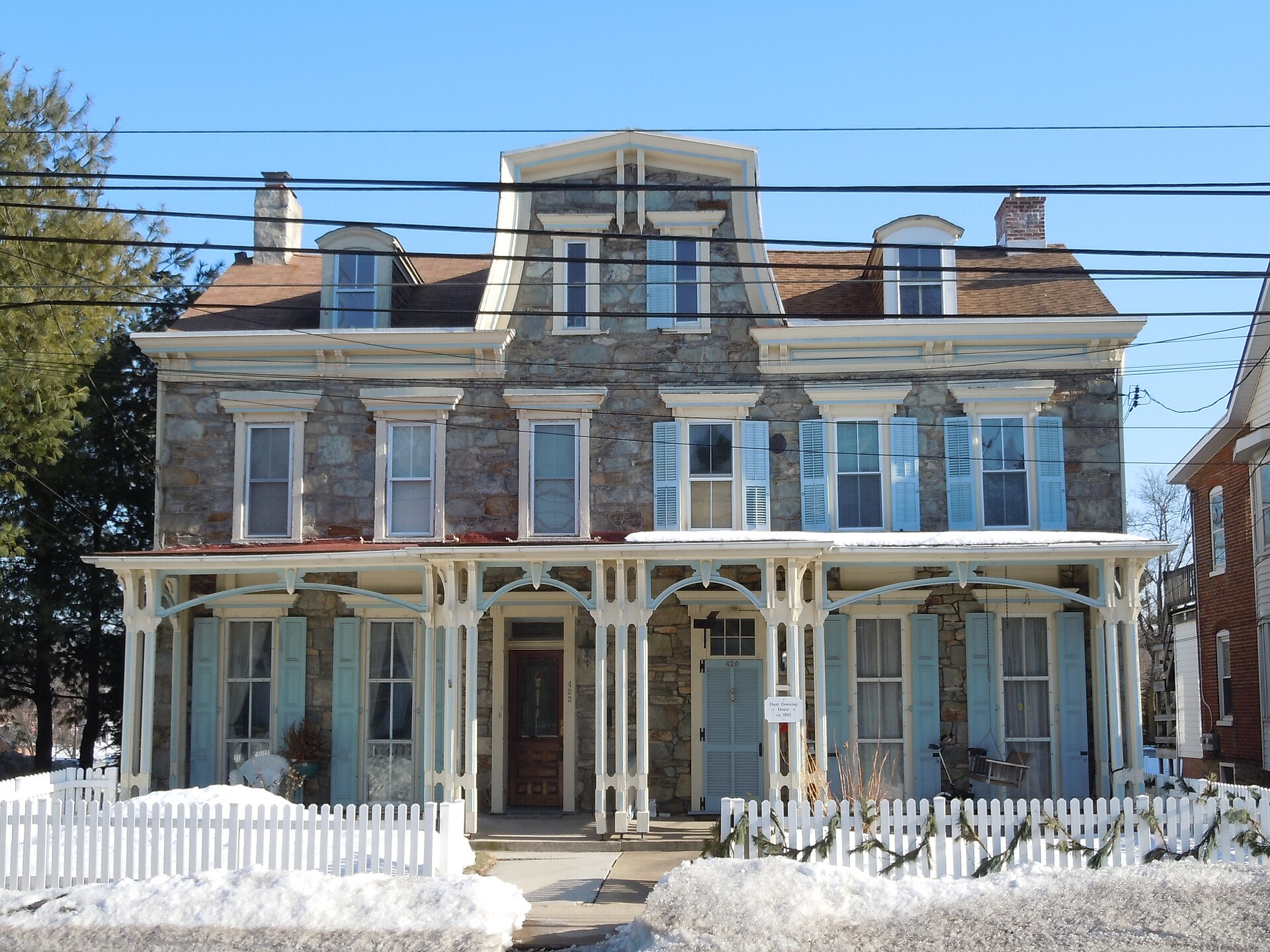
Western Chester County offers something increasingly rare within a reasonable drive of Philadelphia: real acreage, working farmland, and stone houses on quiet roads, paired with a walkable borough and a well-regarded public school district. Chester Springs and Downingtown sit next to each other along that spectrum — one is largely rural and estate-oriented, the other is a compact borough with a downtown. Buyers who look at both often find that the pair covers most of what they want. This guide explains how they differ, what the housing stock looks like, and what to check before you buy out here.
Where they are and how they differ
Chester Springs is a mailing address rather than a municipality, covering parts of West Pikeland, Upper Uwchlan, West Vincent, and neighboring townships. That matters more than it sounds: two houses with the same Chester Springs address can sit in different townships with different zoning, different tax rates, and different local services. Always confirm the actual municipality before drawing conclusions about taxes or permitting.
Downingtown is a distinct borough with a defined downtown along Lancaster Avenue, a train station, and a compact street grid. Surrounding it are East Caln, Caln, Uwchlan, and East Brandywine townships, which contain much of the larger-lot inventory people describe as “Downingtown.”
In broad terms: Chester Springs skews toward larger parcels, older stone farmhouses, custom builds, and equestrian use. Downingtown skews toward a mix of borough homes, established subdivisions, and newer construction, with a genuine walkable center.
The housing stock
Chester Springs
- Historic stone farmhouses, many eighteenth and nineteenth century, often with additions layered on over generations. Character is exceptional; systems and insulation require careful evaluation.
- Custom homes on several acres, frequently built in the last three decades, with the layouts and ceiling heights buyers expect at the high end.
- Equestrian properties with barns, paddocks, run-in sheds, and ring space. Chester County has a deep horse culture, and the infrastructure to support it.
- Newer enclave subdivisions on smaller lots, which trade acreage for lower maintenance.
Downingtown
- Borough homes, including Victorians and early twentieth-century houses on walkable streets near the downtown.
- Established suburban neighborhoods in the surrounding townships, many built from the 1980s onward.
- Newer construction and townhome communities, some with association-maintained exteriors, which appeal to buyers who want low upkeep.
Land, water, and the things suburban buyers forget to ask
Once you move outside the borough, many properties are served by private wells and on-site septic systems rather than public water and sewer. That is entirely normal here and manageable, but it changes your due diligence:
- Well. Test for yield as well as water quality. A well that produces adequately for two people may not support a large house with multiple baths, irrigation, and a pool.
- Septic. Ask for the permit and as-built location, the tank size, the last pumping record, and whether the system is conventional or an engineered alternative. Have it inspected and, where appropriate, hydraulically load-tested.
- Easements and rights of way. Shared driveways, utility easements, and agricultural or conservation easements are common on larger parcels. A conservation easement can meaningfully restrict future subdivision or new structures.
- Act 319 (Clean and Green) enrollment. Some larger parcels carry preferential assessment tied to agricultural or forest use. Changing that use can trigger rollback taxes. Confirm the enrollment status and the implications before you plan any change.
- Stormwater, floodplain, and steep slopes. The Brandywine Creek and its tributaries run through this area. Confirm flood zone status and any township steep-slope or riparian buffer ordinances that could limit an addition or pool.
Schools, commuting, and daily life
Both areas are largely served by the Downingtown Area School District, which has long been one of the reasons families concentrate here; the district’s STEM Academy in particular draws attention from relocating buyers. School attendance boundaries do not follow municipal lines neatly, so verify the assigned schools for a specific address directly with the district rather than relying on a listing sheet.
For commuting, Downingtown has a station on SEPTA’s Paoli/Thorndale Line, with Amtrak Keystone service also stopping there — a real advantage for anyone who works in Center City or travels to New York. By car, Route 30 and the Route 30 bypass carry east-west traffic, Route 100 runs north-south toward Exton and the Turnpike, and the Downingtown Turnpike interchange puts the Northeast Extension and the Valley Forge corridor within reach. From Chester Springs, expect to drive several minutes to any of these.
Day to day, Downingtown’s borough center offers restaurants, coffee, and a farmers’ market atmosphere, with Marsh Creek State Park, the Struble Trail, and extensive preserved open space nearby. Chester Springs life revolves more around the land itself, with Marsh Creek, French Creek, and the surrounding preserved acreage close at hand and the shopping and dining of Exton, Malvern, and West Chester a short drive away.
What to weigh before you choose
The honest trade-off is maintenance and distance versus walkability. A ten-acre property with a stone house and a barn is extraordinary, and it also means a longer driveway to plow, a well and septic to maintain, outbuildings to keep up, and a drive to nearly everything. A borough home or a townhouse in a maintained community gives you the district and the setting with far less to manage.
Buyers who intend to stay for a decade or more and who genuinely want land are well served by Chester Springs. Buyers who want the area’s schools and setting but do not want to become property managers often find Downingtown and the surrounding townships a better fit.
Frequently asked questions
Is Chester Springs a township I can look up?
No — it is a postal designation spanning several municipalities. Because taxes, zoning, and permitting are set at the township level, identify the specific township for any property you are serious about before you make assumptions about millage or what you can build.
How hard is it to renovate or add on to a historic stone house here?
It is very doable, but it takes the right team. Expect to work with a contractor experienced in older masonry, to budget for systems and insulation rather than just finishes, and to check township zoning for setbacks and impervious-coverage limits. Where a property sits in a historic district or carries an easement, exterior changes may need additional review.
Can I keep horses on a Chester Springs property?
Often yes, but it depends on the township’s zoning, the parcel size, and any deed restrictions or association rules. Confirm the permitted number of animals per acre and any manure-management or setback requirements before you buy with horses in mind.
If you are weighing western Chester County against the Main Line, Bucks County, or South Jersey, I can help you compare specific properties on the criteria that actually drive long-term satisfaction — land, systems, school assignment, and commute. Reach James Kennedy at 215-267-8479 or jameskennedy@unlockedteam.com to talk through your search.
Leave a Reply