
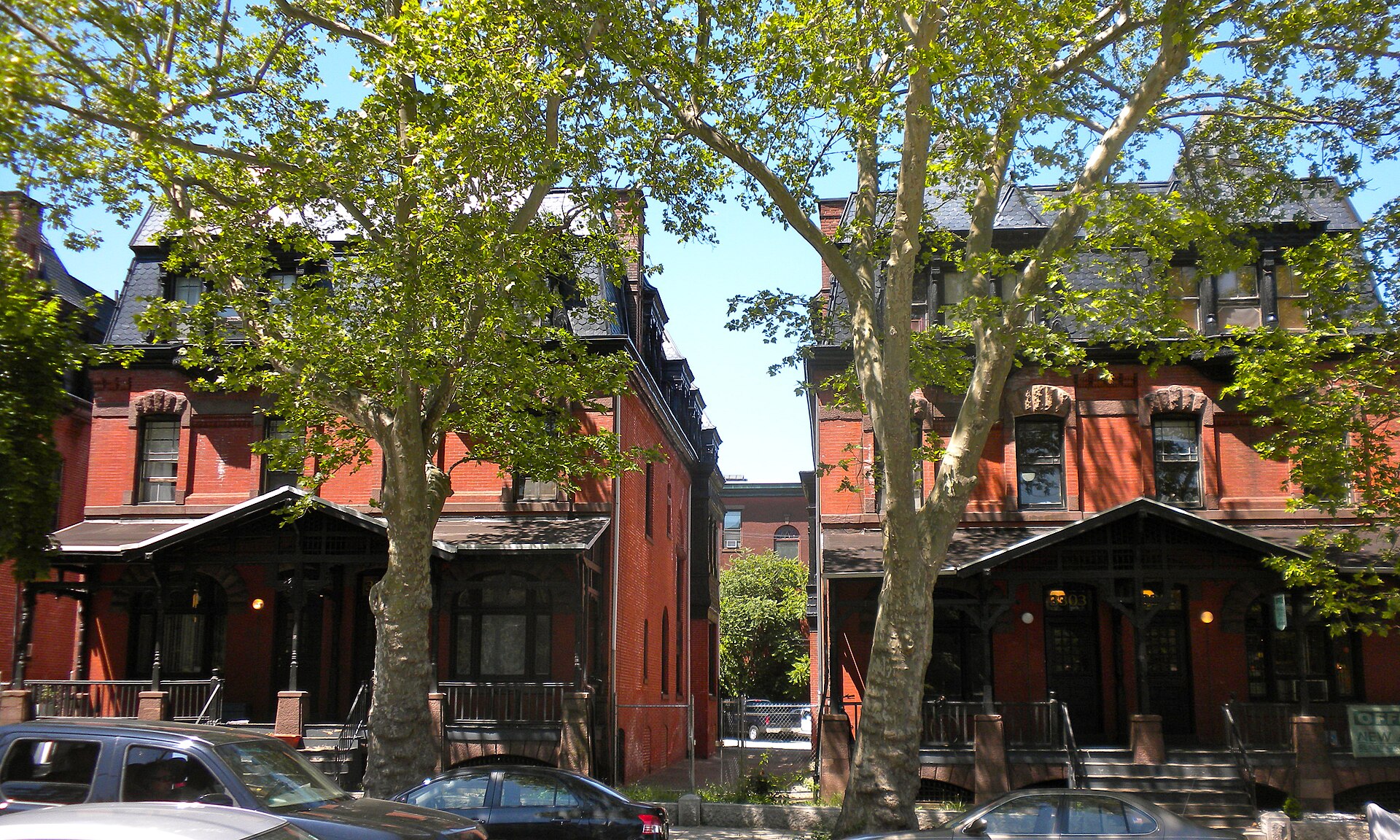
Powelton Village is one of the more surprising places in Philadelphia to find a large, architecturally serious house. Sitting just north of Market Street in West Philadelphia, bounded roughly by the Schuylkill River, Lancaster Avenue, and 40th Street, it is a compact grid of Victorian twins, detached villas, and Italianate mansions built largely between the 1850s and the 1890s. For buyers who want square footage, original detail, and a five-minute commute to 30th Street Station, few Philadelphia neighborhoods offer the same combination.
It is also a neighborhood that rewards knowing what you are looking at. Powelton has a mixed housing stock, a significant student-rental presence, and a historic district overlay that shapes what you can and cannot do to a facade. This guide covers what serious buyers should weigh.
What the housing stock actually looks like
Powelton Village was developed as a streetcar suburb for Philadelphia’s professional class, and it was built with real ambition. The result is a housing stock unlike almost anywhere else in the city:
- Detached and semi-detached Victorians. Deep setbacks, wraparound porches, and side yards are common here in a way they simply are not in Center City. Many houses sit on lots that would be considered suburban by Philadelphia standards.
- Italianate and Second Empire villas. Bracketed cornices, mansard roofs, tall narrow windows, and elaborate porch millwork appear throughout the district.
- Queen Anne houses. Turrets, patterned shingles, stained glass, and asymmetrical massing, often on the larger corner lots.
- Interior scale. Ceiling heights of ten to twelve feet on the main floor are typical, along with original staircases, pocket doors, and multiple carved mantels.
Square footage in the largest houses can run well beyond what a comparably priced Center City townhouse offers. That is the core value proposition of the neighborhood, and it is why the strongest Powelton buyers tend to be people who specifically want a big, old, detached house and are willing to steward it.
The historic district and what it means for renovation
Much of Powelton Village falls within a locally designated historic district, which means exterior alterations visible from the public right of way are reviewed by the Philadelphia Historical Commission. In practice this affects window replacement, porch reconstruction, roofing material on visible slopes, cornice work, railings, and additions.
This is not a reason to avoid the neighborhood. It is a reason to plan differently. A few practical points:
Budget for the review timeline, not just the work
Commission review adds weeks or months to a project schedule. If you are buying with a renovation in mind, build that into your expectations rather than assuming a spring closing means a summer facade.
Interior work is generally unrestricted
Local historic designation in Philadelphia is primarily exterior. Kitchens, baths, systems, and interior layout changes are usually not subject to Commission review, though standard permitting still applies.
Verify prior work was permitted
Older Powelton houses have often passed through decades of landlord ownership. Unpermitted rear additions, decks, and conversions are not unusual, and they can complicate a resale or an insurance claim later. Ask for permit history early.
The rental conversion question
Powelton sits adjacent to Drexel University, and a meaningful share of its large houses were carved into student apartments during the second half of the twentieth century. Buyers looking for a single-family home should look closely at:
- Zoning and legal use. A house marketed as a “single-family” may still be zoned or licensed as a multi-unit property, or vice versa. Confirm the zoning designation and the certificate of occupancy rather than relying on how the house is presented.
- Reversion cost. Turning a six-unit conversion back into a single home is a real construction project: removing kitchenettes, consolidating meters, rebuilding the stair core, and rerunning HVAC. It can be worth it in the right house, but it should be priced into your offer.
- Block character. Some streets are overwhelmingly owner-occupied and quiet; others carry heavy student turnover. In Powelton, the block matters more than the neighborhood average.
Location, commuting, and daily life
Powelton’s location is its quiet advantage. 30th Street Station is within walking distance, which puts Amtrak’s Northeast Corridor, SEPTA Regional Rail to the Main Line and the suburbs, and the Market-Frankford Line all within easy reach. Drivers have quick access to I-76 and the Schuylkill Expressway, and Center City is a short trip across the river.
Day to day, residents draw on Lancaster Avenue and the surrounding University City corridor for restaurants, coffee, and groceries, with Rittenhouse Square and the Schuylkill River Trail a short distance east. Fairmount Park and the Please Touch Museum sit to the north. The neighborhood itself is residential and leafy, with an active civic association and a strong tradition of block-level organizing.
What to inspect carefully
Houses of this age and size deserve a more thorough due diligence process than a standard inspection. Prioritize:
- Roof and gutter systems. Complex Victorian rooflines with valleys, dormers, and mansard slopes are expensive to maintain and are the most common source of interior water damage.
- Structural framing and porches. Wood porches and their supporting columns often carry decades of deferred maintenance.
- Systems capacity. Knob-and-tube remnants, undersized electrical service, and aging boilers are common. Ask what an insurer will require.
- Masonry and pointing. Brownstone and brick facades on these houses need periodic repointing, and the work is specialized.
- Lead and asbestos. Standard concerns in pre-1978 housing, and worth testing rather than assuming.
Who Powelton Village suits
The neighborhood tends to appeal to buyers who value original architecture and interior volume over turnkey finishes, who want proximity to the universities, hospitals, and Amtrak, and who are comfortable owning an older building. It is a strong fit for academics and medical professionals, for families who want a yard without leaving the city, and for buyers who have looked at Center City townhouses and concluded they want more house for the money.
It is a weaker fit for someone who wants a new-construction condo experience, doorman services, or a maintenance-free lifestyle. Those buyers are usually better served in Rittenhouse, Logan Square, or along the waterfront.
Frequently asked questions
Is Powelton Village a good place to buy a large family home in Philadelphia?
It can be an excellent option for buyers who want a detached or semi-detached Victorian with a yard and real interior scale while staying inside the city. The key is choosing the right block and confirming the house is a true single-family use rather than a conversion, since both exist side by side in the neighborhood.
Does the historic district make renovating a Powelton home difficult?
It adds a review step for exterior changes visible from the street, which lengthens timelines and narrows material choices. Interior renovations are generally not affected. Owners who plan for the review process early and work with contractors who have handled Historical Commission projects usually find it manageable.
How does Powelton Village compare to Spruce Hill or Cedar Park?
All three are West Philadelphia Victorian neighborhoods, but Powelton is smaller, closer to 30th Street Station and Drexel, and more compact. Spruce Hill and Cedar Park are larger, more residentially settled, and sit closer to the University of Pennsylvania. The right choice depends on your commute, the specific house, and the character of the block.
Thinking about a Victorian in Powelton Village or elsewhere in Philadelphia? James Kennedy specializes in luxury and historic properties across Philadelphia and South Jersey, and can walk you through block-level differences, permit history, and what a specific house will realistically cost to own. Call James at 215-267-8479 or email jameskennedy@unlockedteam.com to talk through your search.
Leave a Reply