
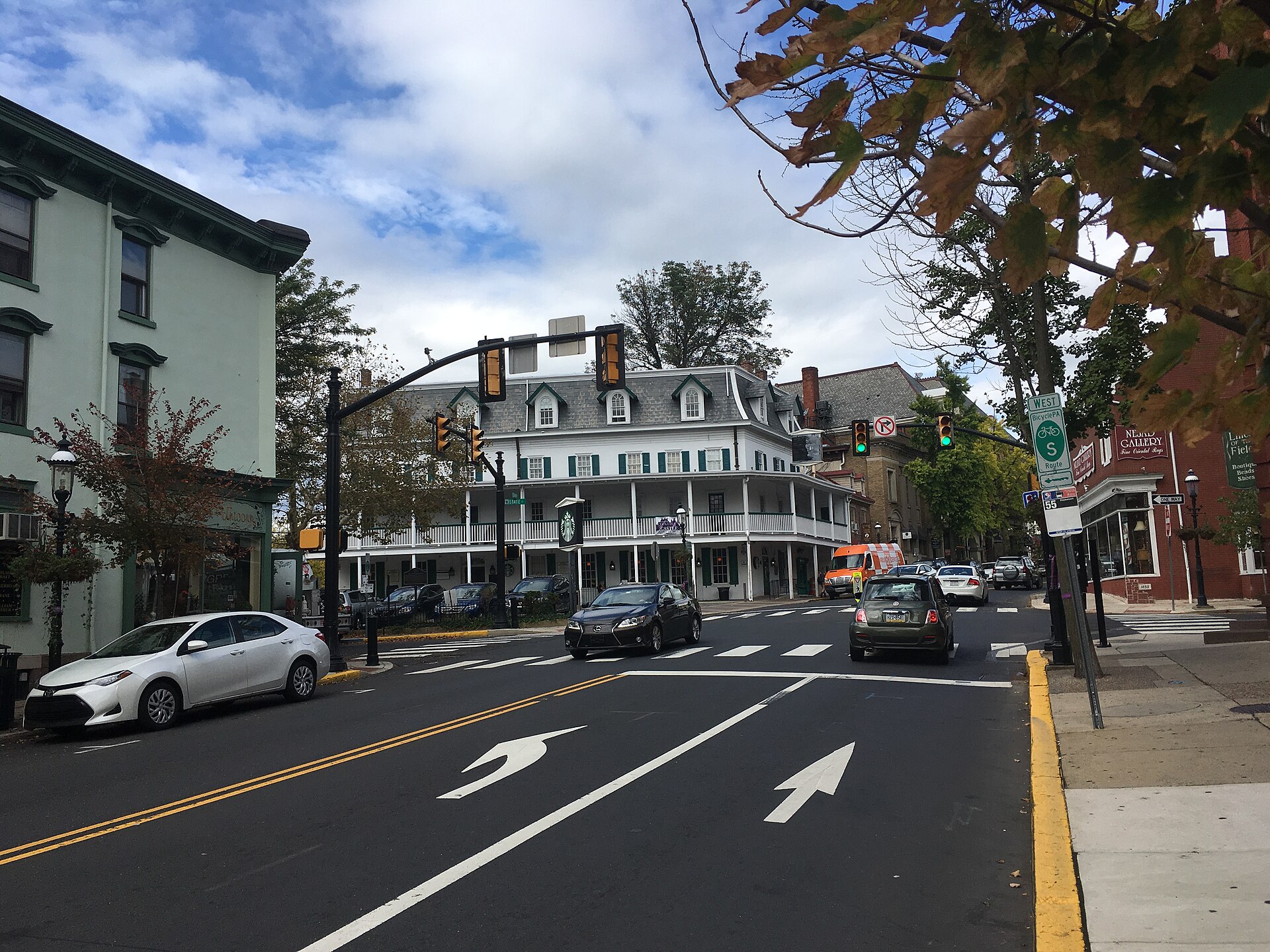
Buyers touring the Philadelphia region for a high-end home often work a familiar triangle: Center City, the Main Line, and the South Jersey suburbs. Doylestown sits outside that triangle, and that is much of its appeal. The Bucks County seat pairs a genuinely walkable historic borough with rolling countryside, a serious arts and museum culture, and an inventory of homes — from Federal-era townhouses to stone farmhouses on acreage — that is difficult to replicate anywhere else within reach of Philadelphia. Here is what luxury buyers should understand about it.
The setting
Doylestown is roughly an hour north of Center City, positioned in central Bucks County where the suburban edge gives way to farmland, preserved open space, and the Delaware River corridor. The borough itself is compact and historic — a courthouse town with a dense, tree-lined core of nineteenth-century architecture — while the surrounding township offers larger parcels, long driveways, and privacy.
That pairing is the essential Doylestown proposition: you can walk to dinner from a Victorian in the borough, or you can own several acres of Bucks County countryside ten minutes away and drive in when you want company. Most affluent submarkets force a choice between those two lives. Doylestown does not.
What the housing stock looks like
Doylestown’s inventory is unusually varied at the upper end, and buyers should understand the categories before they tour.
Borough historic homes
The borough contains a dense concentration of well-preserved nineteenth-century architecture — Federal, Greek Revival, Italianate, Queen Anne, and Victorian homes on modest lots within walking distance of the courthouse, shops, and restaurants. These are for buyers who want walkability and period character and are comfortable with the realities of an older structure: original systems, restoration requirements, and limited off-street parking.
Stone farmhouses and estate properties
Bucks County’s signature property type is the fieldstone farmhouse, often eighteenth or nineteenth century, frequently expanded over generations, and typically sited on acreage with barns or outbuildings. These are the homes that made the county’s reputation, and they attract buyers specifically seeking that architecture. They also demand the most diligence — masonry, roofs, wells, septic systems, and additions of varying quality all require expert evaluation.
Newer construction and planned communities
The township and surrounding area include newer homes and developments offering contemporary layouts, modern systems, and larger square footage without the maintenance profile of a historic property. For buyers who want the setting without the restoration project, this is where they land.
Equestrian and land-holding properties
Central Bucks supports genuine equestrian use, and larger parcels with barns, paddocks, and riding facilities exist within reach of the borough. Land preservation is a meaningful feature of the county, which shapes both what can be built and what surrounds you long-term.
The culture is real, not decorative
Many suburbs claim an arts scene. Doylestown has an unusually substantive one for a town its size, anchored by institutions rather than marketing. The Mercer Museum and Fonthill Castle — both concrete constructions by Henry Chapman Mercer — are legitimately singular buildings, and the Michener Art Museum holds a serious collection with a strong regional focus. The County Theater operates as an art house cinema in the borough core. The result is a downtown with genuine evening activity, independent restaurants, and a year-round calendar that does not depend on a mall.
For buyers relocating from a major city who worry about suburban flatness, this matters. Doylestown gives back a version of what they are leaving.
Getting to Philadelphia — and elsewhere
Doylestown sits at the end of a SEPTA Regional Rail line running into Center City, which makes a car-free commute possible. It is not a short ride, and buyers who need to be at a Center City desk five days a week should test it before committing rather than reasoning from a map. For hybrid schedules — two or three days in the office — the trade is far more comfortable, and this has broadened Doylestown’s appeal considerably.
The county’s position also opens options that Main Line and South Jersey buyers do not have. Central New Jersey and the Princeton corridor are accessible, and New York is reachable for occasional trips. Buyers splitting time between Philadelphia and points north often find Bucks County the practical midpoint.
How to approach a Doylestown purchase
- Decide borough or township first. These are different lifestyles at similar price points, and touring both without a thesis wastes months.
- Take historic diligence seriously. A stone farmhouse deserves inspectors who understand old masonry, not a generalist. Budget for what you find.
- Understand wells and septic systems. Outside the borough these are common, and they require testing, understanding, and ongoing maintenance that city buyers have never had to think about.
- Check what is preserved nearby. Bucks County’s open space programs affect your long-term view and your neighbors. This is usually a benefit — but know it rather than assume it.
- Verify permits on additions. Historic homes accumulate work over decades, and not all of it was permitted.
- Confirm current taxes and school district lines for the specific parcel rather than relying on general assumptions about the area.
Who Doylestown fits
Doylestown works for a buyer who wants space and privacy without giving up a walkable town, who values architectural character, and whose schedule does not demand a daily downtown commute. It works less well for someone who needs to be in Center City every morning, or who wants new construction on a manicured lot and finds old buildings a burden rather than a draw.
It is also a market where local knowledge compounds. The gap between a beautifully restored farmhouse and a superficially updated one is not always visible on a tour, and it is expensive to learn afterward.
Frequently asked questions
How far is Doylestown from Center City Philadelphia?
Doylestown sits roughly an hour north of Center City by car, with SEPTA Regional Rail service into the city as well. The rail ride is longer than what Main Line commuters are used to, which makes Doylestown a strong fit for hybrid or flexible schedules and a harder fit for a daily five-day office commute. Test the actual trip at your real commuting hour before deciding.
What kind of luxury homes does Doylestown offer?
The upper end spans historic borough homes within walking distance of downtown, eighteenth and nineteenth century fieldstone farmhouses on acreage, newer construction with modern systems and layouts, and equestrian properties with barns and paddocks. That range is unusually wide for one market, which is why defining what you want before touring saves considerable time.
What should I inspect carefully in a Bucks County farmhouse?
Stone masonry and pointing, roof condition, the quality and permitting of past additions, structural framing, and the well and septic systems if the property is outside the borough. Older homes also warrant attention to electrical service, heating systems, drainage, and any underground oil tanks. Use inspectors with specific historic-property experience rather than a general home inspector.
Bucks County rewards buyers who know what they are looking at. If you are considering Doylestown or the surrounding area and want honest guidance on borough versus township, historic versus new construction, and what a specific property will actually require of you, reach out to James Kennedy at 215-267-8479 or jameskennedy@unlockedteam.com.
Leave a Reply